 Flarnex
Cordless or petrol: what 48 volts really gets you
Ten years ago a battery garden tool was a compromise. For most gardens it no longer is. For a few, petrol still wins — here is how to tell which garden you have.
18 September 2026
What changed
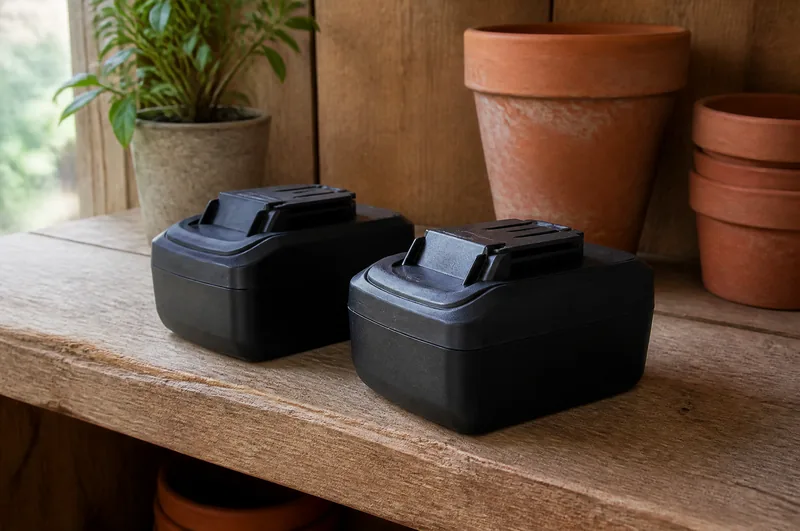
Two things. Lithium batteries got denser, so the same weight now stores far more energy. And brushless motors arrived, which waste less of that energy as heat. Put together, a 48-volt tool now delivers the kind of power that used to need a small engine.
The number on the battery matters. Voltage is roughly how hard the tool can push; amp-hours (Ah) is roughly how long it can keep pushing. A 48V, 2.5Ah battery is a good balance for most garden work.
Where cordless now wins outright
- Starting. Press the trigger and it runs. No choke, no pull cord, no flooding the engine.
- Upkeep. No spark plug, no air filter, no fuel going stale in the shed over winter.
- Weight and balance. No fuel tank sloshing about, so the tool is lighter and steadier to hold.
- Noise. Far quieter, so you can start early without upsetting the street.
- Fumes. None, which you notice most when working close to the house or in a greenhouse.
Where petrol still has the edge
Runtime on big jobs. If you have a large plot and want to trim or cut for hours without stopping, a tank of fuel refills in seconds while a battery takes hours to charge. For very large properties or professional use, petrol still makes sense.
Very heavy cutting is the other case. A compact cordless chainsaw handles branches up to about 10 cm comfortably, but felling a tree is a different job for a different tool.
Will a battery last your job?
Here is a rough guide to how long our cordless tools run on a single charge. Real runtime depends on how hard you work the tool.
| Tool | Runtime per charge | Batteries included |
|---|---|---|
| Cordless pruner 48V | 3 to 4.5 hours | 2 |
| PowerBlower 48V | About 30 minutes | 1 |
| Cordless trimmer 48V | Varies with grass density | 2 |
| Cordless pressure washer 48V | Varies with nozzle setting | 2 |
Two batteries change the maths completely. Charge one while you use the other, and the only real limit is how long you want to be out there.
Looking after the batteries
Lithium batteries last longest when they are not stored completely full or completely empty. Over winter, keep them indoors at around half charge, away from frost. Do not leave them in a car in summer or in a cold shed in January. Treated this way, a battery will give you several seasons of use.
Batteries are covered by the three-year legal guarantee. A battery that can no longer hold a reasonable charge well within that period is a fault, and we will put it right. The gradual, expected loss of capacity over many charges is normal wear. Details on the warranty page.
So which should you choose?
For a typical home garden, choose cordless. You will spend less time maintaining the tool and more time using it. Choose petrol only if you are clearing large areas for hours at a stretch, or doing work that is really professional-grade.
Not sure which camp you are in? Tell us about your garden at support@flarnex.com and we will give you an honest answer, even if it is that you need something we do not sell.